
AI analytics for ophthalmology practices.
Built for Nextech® practice management. Connect the data warehouse subscription you already have, and give your whole team a way to ask it questions.
Medical practice AI analytics, without the analyst.
Type the question the way you'd say it out loud. The AI writes and runs the query against your data warehouse and answers with the number, the chart, what it noticed, and the next three questions worth asking.
- →Answers arrive in seconds, across millions of billing rows.
- →Every answer can be opened — see the underlying rows, not just the total.
- →Follow-ups keep context, so you can dig without restating the question.
- →The platform meters its own AI cost per practice, so spend is never a surprise.
- →It carries your practice's name, not ours — your subdomain, your name in the sidebar and the browser tab.
A worked example. An administrator asks why collections dropped in May. The answer comes back in seconds: collections fell 9%, but charges were flat — the gap is a single payer whose average days to payment moved from 31 to 58 after a claims-system migration on their end. One follow-up produces the 84 claims sitting in that gap, with balances. That is a phone call to a payer representative with a claim list attached, which is a different thing entirely from a line on a chart pointing downwards.
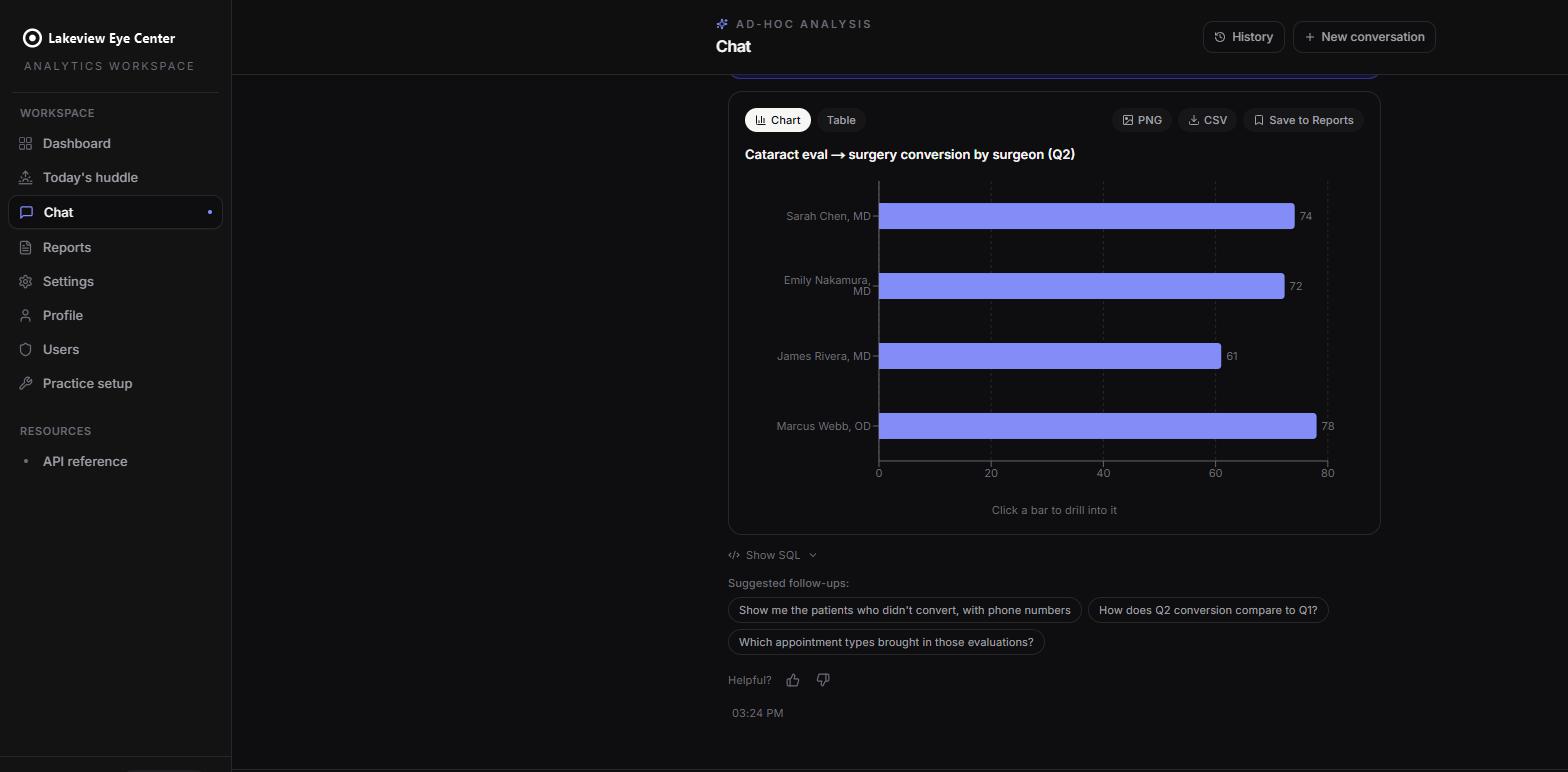
Every answer carries a Show SQL toggle, so the query behind the number is never hidden from you.
- “How many cataract evals converted to surgery last quarter?
- “Which payers denied the most claims in July, and for what reason?
- “Show me every patient overdue for an OCT who has an appointment this month.
- “What's Dr. B's premium IOL conversion compared to the practice average?
- “Why did collections drop in May?
The ophthalmology KPI dashboard, drillable to the patient.
Revenue, collections, appointments, no-shows, surgical volume, premium IOL conversion, new-patient growth — and a way into every one of them.
Revenue & collections
Charges, payments, adjustments, and net collection rate by period, provider, location, and payer.
Surgical volume & yield
Cases by type and surgeon, ASC vs. hospital, and the conversion funnel that feeds them.
Premium IOL conversion
Evaluation to quote to scheduled to performed — by surgeon, by counselor, by month.
Appointments & no-shows
Utilization by clinic day and appointment type, with the no-show and cancellation patterns behind it.
New-patient growth
Volume, source, and referring provider — including which referrers have gone quiet.
Provider productivity
Encounters, wRVUs, procedure mix, and clinic throughput, provider by provider.
The 7 AM view.
Today's book by appointment type, surgeries, new patients, care-gap flags, the next clinic day look-ahead, and yesterday's results. Providers see their own day; leadership toggles to the whole practice.
It's designed for phones and tablets first, because that's what people are holding when the huddle actually happens — standing in a hallway at 7 AM, not sitting at a desktop.
The care-gap flags are the part practices tend to notice first. A patient arriving today for a glaucoma follow-up who is fourteen months past due for an OCT is flagged before they're roomed. The test happens at a visit they already booked, which is better for the patient and costs nobody an outreach call.
Care-gap flags
The patient in today's chair who is overdue for an OCT, a visual field, or a diabetic exam — flagged before they're roomed, not after they've left.
Look-ahead
Tomorrow's gaps while there's still time to fill them.
Yesterday, closed out
What was scheduled, what happened, what didn't, and what needs a phone call.
30+ Nextech data warehouse reports, built in.
The reporting your billing team has been assembling by hand, already written — and every aggregate opens to the patients behind it.
A/R aging
By payer, provider, and bucket, drilling to individual claims.
Denials
Reason codes ranked by dollars, not just by count.
Claim rejections
Front-end rejections before they become denials.
Payer mix
Volume and yield by payer, trended.
Net collection rate
By period, provider, and location.
Surgical yield
Evaluations in, cases out, by surgeon.
Referring providers
Who sends, how much, and who stopped.
Provider productivity
Encounters, procedures, and throughput.
Every one of these ends in records rather than a total. Click a 6.8% no-show rate and you get the patients who missed last month, sorted by how many times they've done it — which is the list the front desk needs to decide who gets a reminder call and who gets a deposit policy. Click an A/R bucket and you get the claims, with payer, age and balance, ready to work in the order that recovers the most money.
Everything exports. The numbers you present to your partners are the numbers you can hand them.
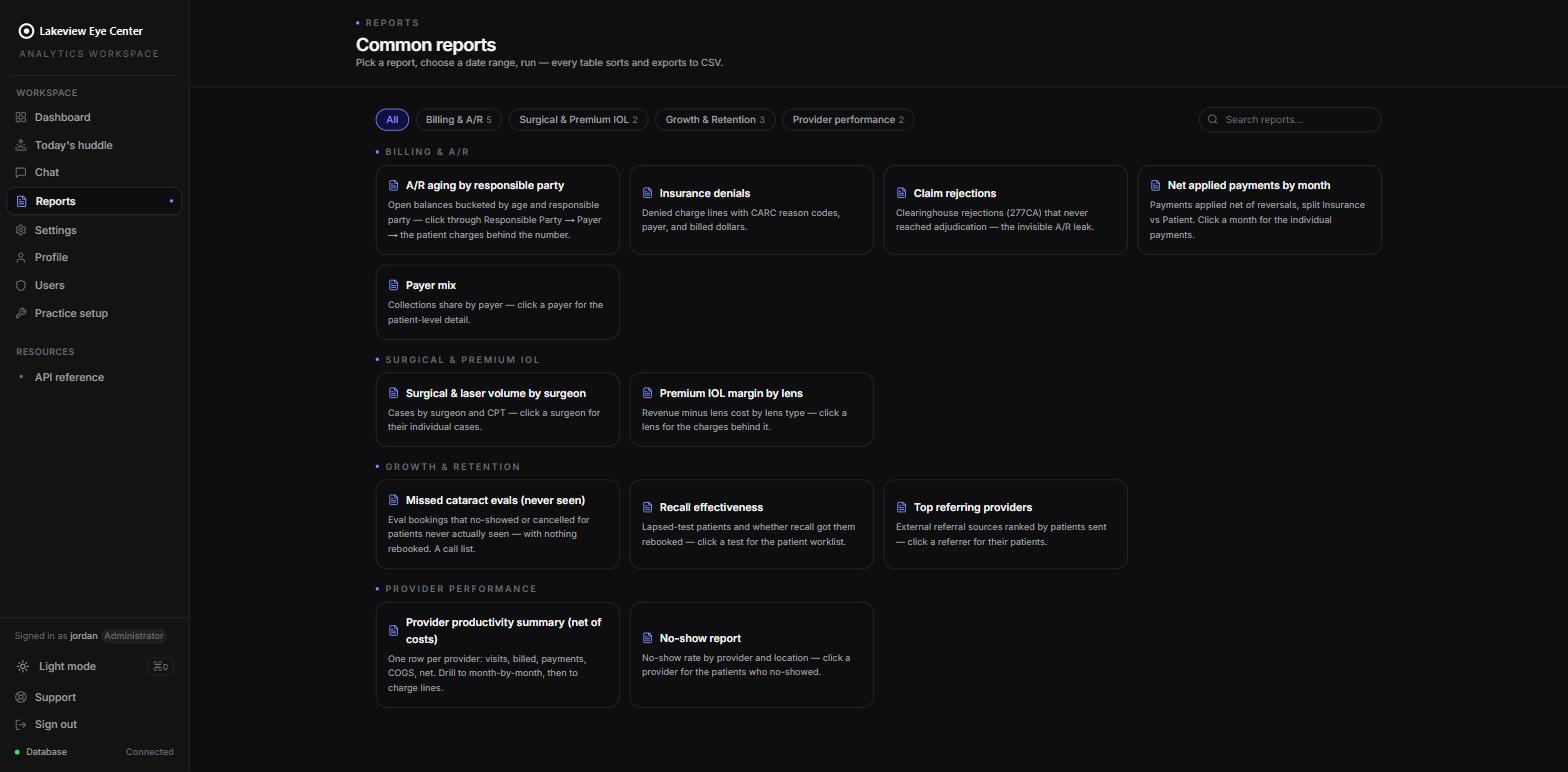
The real report library. Fictional practice data.
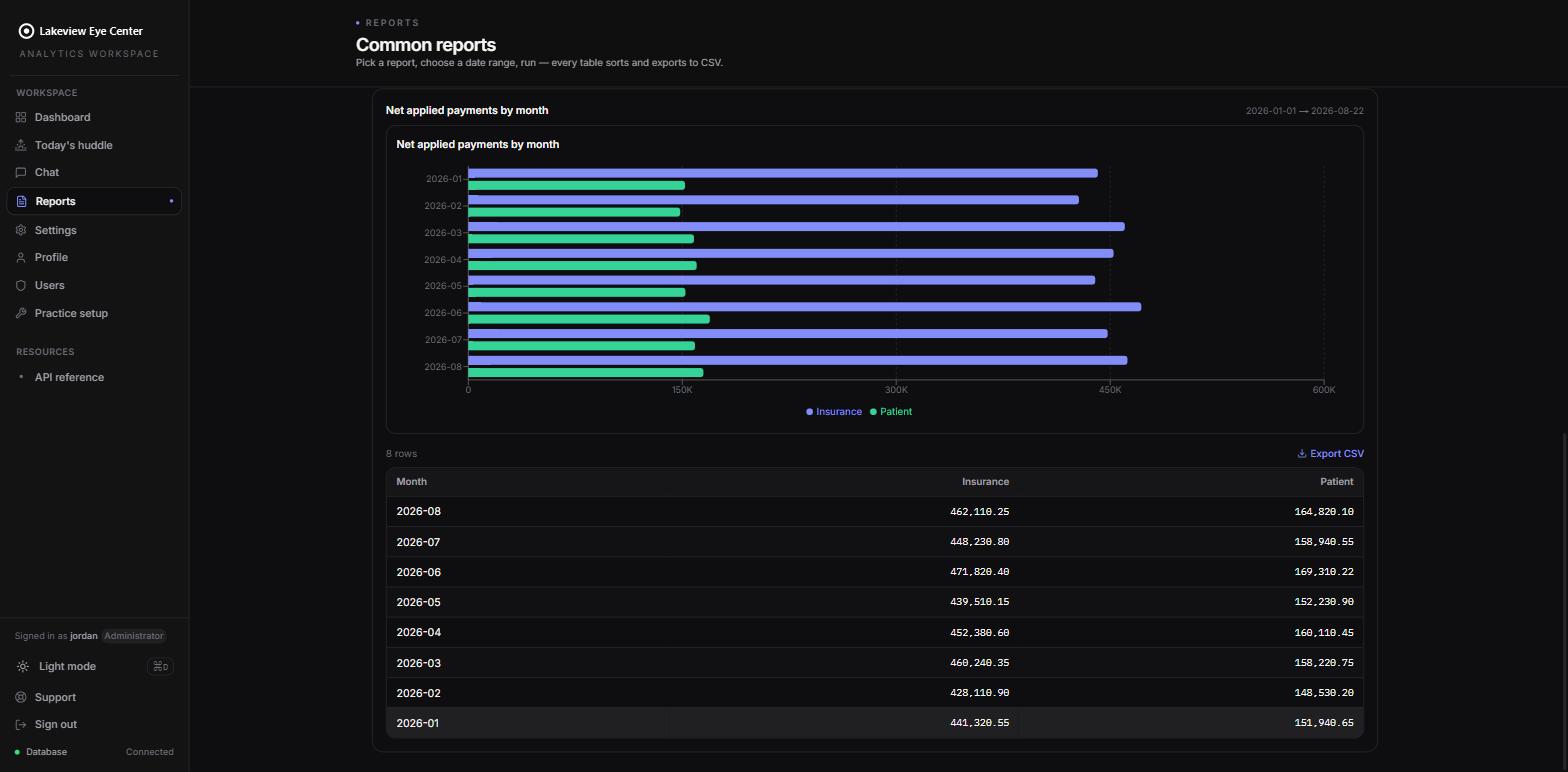
Any report opens to a chart, a sortable table, and a CSV export.
Business financials
Connect QuickBooks® and operating margin, expenses, payroll, and cash sit next to collections and surgical volume — so the clinical picture and the business picture are finally on one screen. Owner and executive roles only.
The question this answers is the one owners actually ask: what did a slow surgical month cost us? Production and overhead in the same view turns that from an argument into a number.
Practice-tuned AI
Your procedure codes, provider names, appointment vocabulary, and costs are editable in the app and feed the AI immediately. Add your own instructions — "a combo case means cataract + MIGS in the same eye" — and the next answer respects it.
HIPAA-focused architecture.
Your own database
Each practice gets its own subdomain and its own isolated database. One practice's data can never touch another's.
Role-based, audit-logged
Admin, analyst, billing, front desk, provider, and clinical roles. Financial data invisible to non-financial roles. Every query audit-logged.
PHI masked at the database layer
Protected health information is masked where it lives, not only where it is displayed.
Azure and AI under BAA
Runs on Microsoft Azure under a Business Associate Agreement. The AI provider is covered by a BAA with abuse-monitoring retention disabled.
PremNET describes its own architecture. We do not claim HIPAA certification — no such certification exists — and we do not promise compliance outcomes on your practice's behalf. Your security officer is welcome on the technical call.
What do you need from our practice to get started?
Two things: an active Nextech data warehouse subscription and SFTP credentials for it. That's the connection. We don't need access to your Nextech application, and nothing about your clinical workflow changes.
How long does onboarding take?
Once credentials are in place, we stand up your subdomain and isolated database, load your history, and tune the AI to your codes, providers, and vocabulary. We'll give you a specific timeline on the demo call rather than a marketing number here.
Do you write anything back into Nextech?
No. PremNET Analytics reads from your data warehouse. It links out to Nextech so you can open a chart in context, but it does not modify your practice management data.
We run ModMed / another system. Can you help?
Not today — the product supports Nextech, and we'd rather say so than overpromise. Additional practice management systems are on the roadmap, and knowing which ones people are asking for shapes that roadmap. Talk to us.
Is PremNET affiliated with or endorsed by Nextech?
No. PremNET Group is an independent company — we are not affiliated with, endorsed by, or certified by Nextech Systems, LLC, and references to Nextech on this site describe compatibility only. PremNET Analytics reads from the data warehouse subscription your practice licenses directly from Nextech, and the data it reads is your practice's own.
Who in the practice can see financial data?
Only the roles you grant it to. Access is role-based — admin, analyst, billing, front desk, provider, clinical — and financial data is invisible to non-financial roles. Business financials from QuickBooks are restricted further, to owner and executive roles. Every query is audit-logged.
Can we trust an AI to get the number right?
Don't trust it — check it. Every answer opens to the rows underneath it, so you can see exactly which encounters, claims, or patients produced the number. That's the point of the drill-down, and it's the first thing we'll show you on a demo.
How is this different from the reports already in Nextech?
Nextech's reporting answers the questions someone anticipated when the report was written. PremNET answers the question you have right now, in the words you'd use to ask a colleague, and hands you the patient list behind the answer. The practical difference is what happens next: a built-in report ends at a number, and a PremNET answer ends at a worklist with phone numbers that a staff member can start calling.
We read from your Nextech data warehouse. We don't replace your practice management system and we don't change how your clinic runs.
What is a Nextech data warehouse subscription, and do we have one?
It's an add-on from Nextech that delivers a copy of your practice's billing and scheduling data to a database you can query, rather than only viewing it inside the application. It's licensed separately from your core Nextech subscription, so some practices have it and don't use it, and some don't have it yet.
If you're not sure, your Nextech account representative can tell you in one email. If you don't have it, you'll need it — it's the connection PremNET Analytics reads from.
Do we need an analyst or anyone technical to run this?
No. There is no report builder to learn, no SQL, and no ticket to IT. The people who get the most out of it are administrators and practice managers who know which questions matter — not people who know how to write a query.
Can providers see each other's numbers?
Only if you allow it. Surgeons see their own production by default, the front desk sees the worklists they call from, administrators see the practice, and financial data stays with the roles you grant it to. It's set once and enforced everywhere, and every query is audit-logged.
How does the AI know what our practice means by a given term?
Because you tell it. Your providers, locations, procedure codes, appointment types, and costs are editable in the app and feed the model immediately, and you can add your own definitions in plain English — "a combo case means cataract + MIGS in the same eye." After that, "premium IOL conversion" means the same thing to the model as it does in your hallway.
Is our patient data used to train AI models?
No. Your data lives in your own isolated database, protected health information is masked at the database layer, the platform runs on Microsoft Azure under a Business Associate Agreement, and the AI provider is covered by a BAA with abuse-monitoring retention disabled. We're happy to walk your security officer through the architecture on a technical call.
What if the AI gets an answer wrong?
Then you'll see it, because every answer opens to the rows that produced it. That's the design: you are never asked to trust a number you can't audit. If an answer is wrong it's almost always because the question was ambiguous or a practice-specific term wasn't defined yet — both of which you fix in the app, and the next answer respects the correction.
We also reconcile to your practice management system on a defined set of totals during onboarding, so you start from agreement rather than hoping for it.
How often does the data refresh?
Your Nextech data warehouse delivers on a schedule set by your contract with Nextech, and we load on that cadence. So PremNET is as current as your warehouse delivery — not live to the second, which matters for a few operational questions and for almost none of the financial ones. We'll confirm the specific timing for your practice during onboarding.
What happens to our data if we stop using PremNET?
It's your data. On termination we transfer it to you in a standard format and delete our copy, and both of those are written into the agreement rather than left to good intentions. Ask us to show you that clause before you sign — it's a reasonable thing to want in writing.
Do you support multiple locations or multiple practices?
Multiple locations within one practice, yes — location is a dimension you can filter and compare on throughout. Genuinely separate legal entities are separate tenants with separate databases, which is a deliberate consequence of the isolation model. If you're a group with shared ownership across entities, tell us the structure on the call and we'll explain how it maps.
Does this replace our billing company or RCM vendor?
No, and it isn't trying to. PremNET reports on what your billing operation produces — denials, aging, net collection rate, the claims behind each — which makes it a way to hold that operation to account, whether it's in-house or outsourced. Several practices use it precisely to have a better-informed conversation with their RCM vendor.
Who at the practice usually owns this?
Most often the administrator or practice manager, with the owner or managing physician looking at the executive view and the front desk working the call lists. It needs one person who cares whether the numbers get acted on. Practices where nobody owns it get the same result they'd get from any analytics tool, which is a login nobody uses.
What does it cost?
Pricing depends on practice size and what you connect, so we quote it on a call rather than publishing a number that wouldn't apply to you.
Bring your hardest question.
Thirty minutes, your data model, and the report your current tools can't produce.