
Ask your practice anything.
AI analytics for ophthalmology practices. Ask a question in plain English, get the answer in seconds, and click straight through to the patients behind the number.
Built inside a working multi-surgeon ophthalmology practice — not in a vacuum.
Read-only · queries are validated · conversations saved to your history
This demo is interactive — click any follow-up question and it runs, exactly as it would in the product. A working replica of the app's chat, styled from its own design tokens; the screenshots below are the real application running against fictional data, so there is no PHI.
The morning huddle, already built.
Today's book by appointment type. Surgeries. New patients. Care-gap flags. Yesterday's results and tomorrow's look-ahead. One screen the whole team stands around — and it reads properly on a phone, because that's where half of them are standing.
- →Providers see their own day; leadership toggles to the whole practice.
- →Care-gap flags surface the patient in the chair who is overdue for something.
- →Next clinic day look-ahead, so open slots get filled before they're wasted.
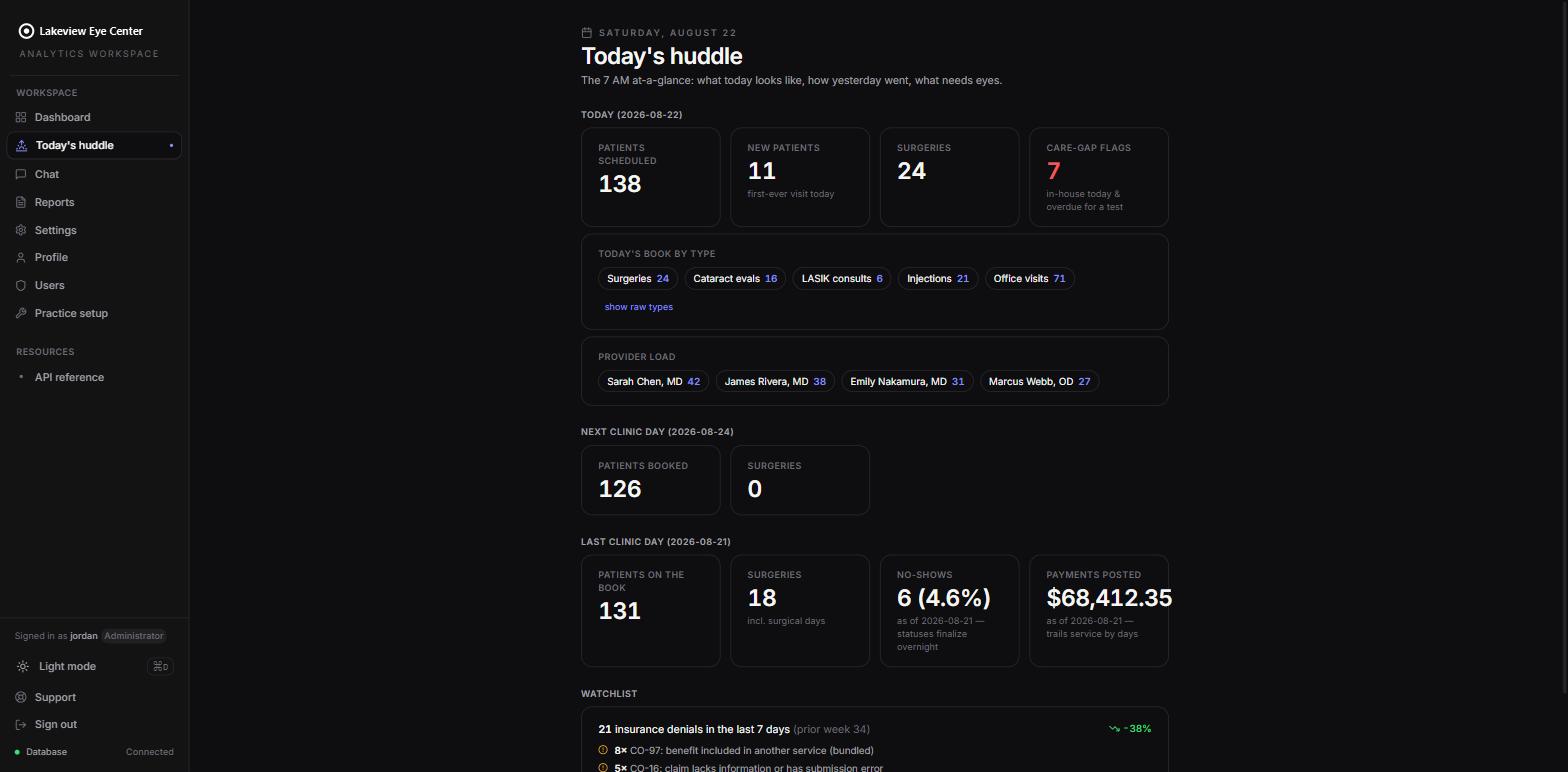
The real huddle screen. Practice, providers and patients are fictional.
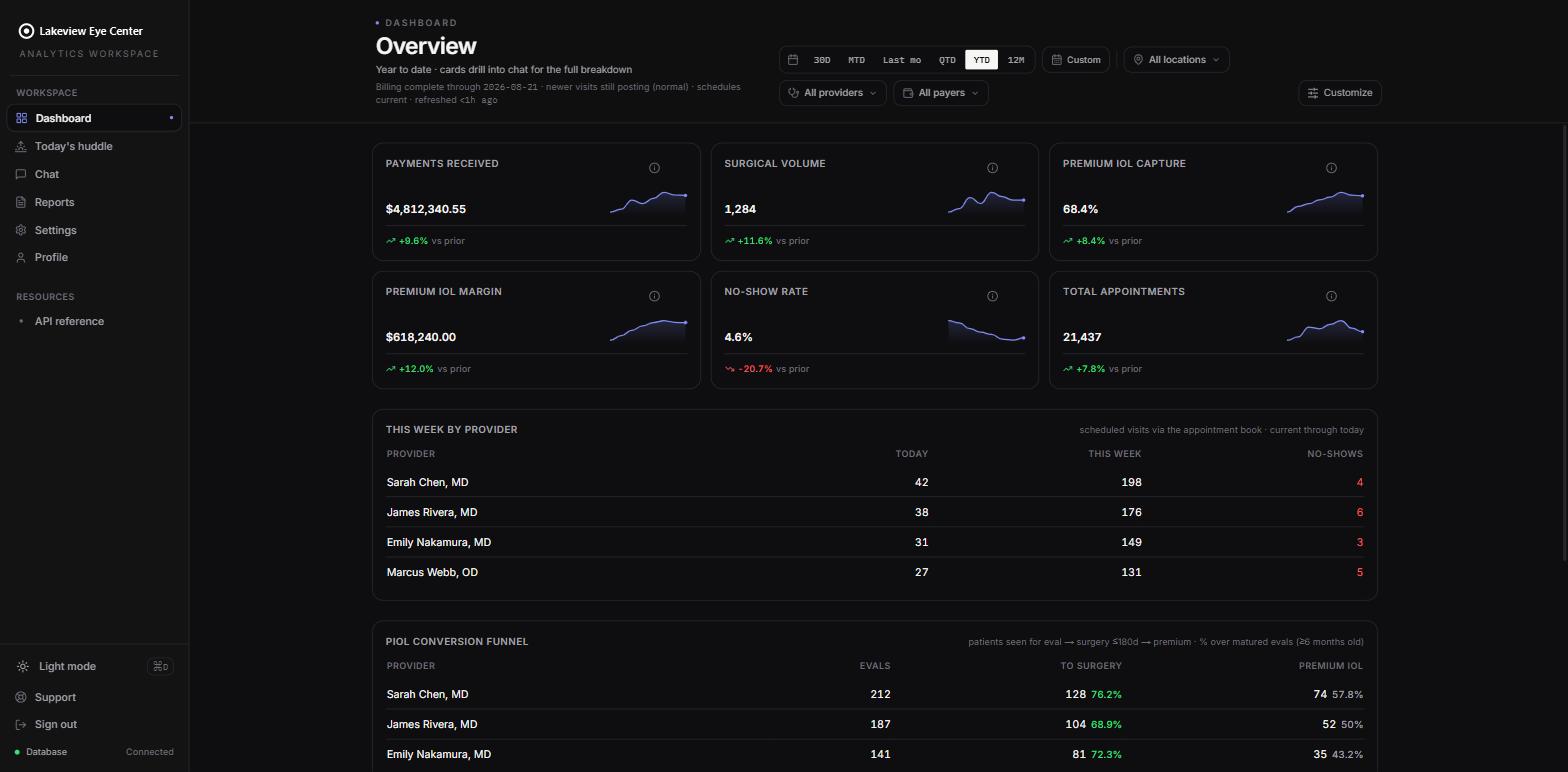
The real dashboard. Every card drills into chat for the full breakdown.
Every number opens.
Revenue, collections, appointments, no-shows, surgical volume, the premium IOL conversion funnel, new-patient growth. Nothing is a dead end: click a card and you get the detail behind it, down to the patient, with a link that opens the patient's chart in your EHR.
- →30+ built-in reports — A/R aging, denials, claim rejections, payer mix, net collection rate, surgical yield, referring providers, provider productivity.
- →Everything exports, so the numbers you present are the numbers you can hand over.
- →Optional QuickBooks® integration puts operating margin, expenses, payroll, and cash next to the clinical numbers — owner and executive eyes only.
Not insight for a board deck.
Most analytics tools tell you a number went down. These reports tell you which patients, and give you the phone numbers. Missed cataract evals, patients lost after evaluation, lapsed-testing worklists — each one a list with phone numbers attached. Calls your staff can make today.
- →Missed cataract evals — patients who met criteria and were never scheduled.
- →Lost after evaluation — evaluated, quoted, never converted, never followed up.
- →Recall and lapsed testing — overdue OCT, visual fields, diabetic exams, IOP checks.
- →Every list exports to a call sheet, and every row links back into the chart.
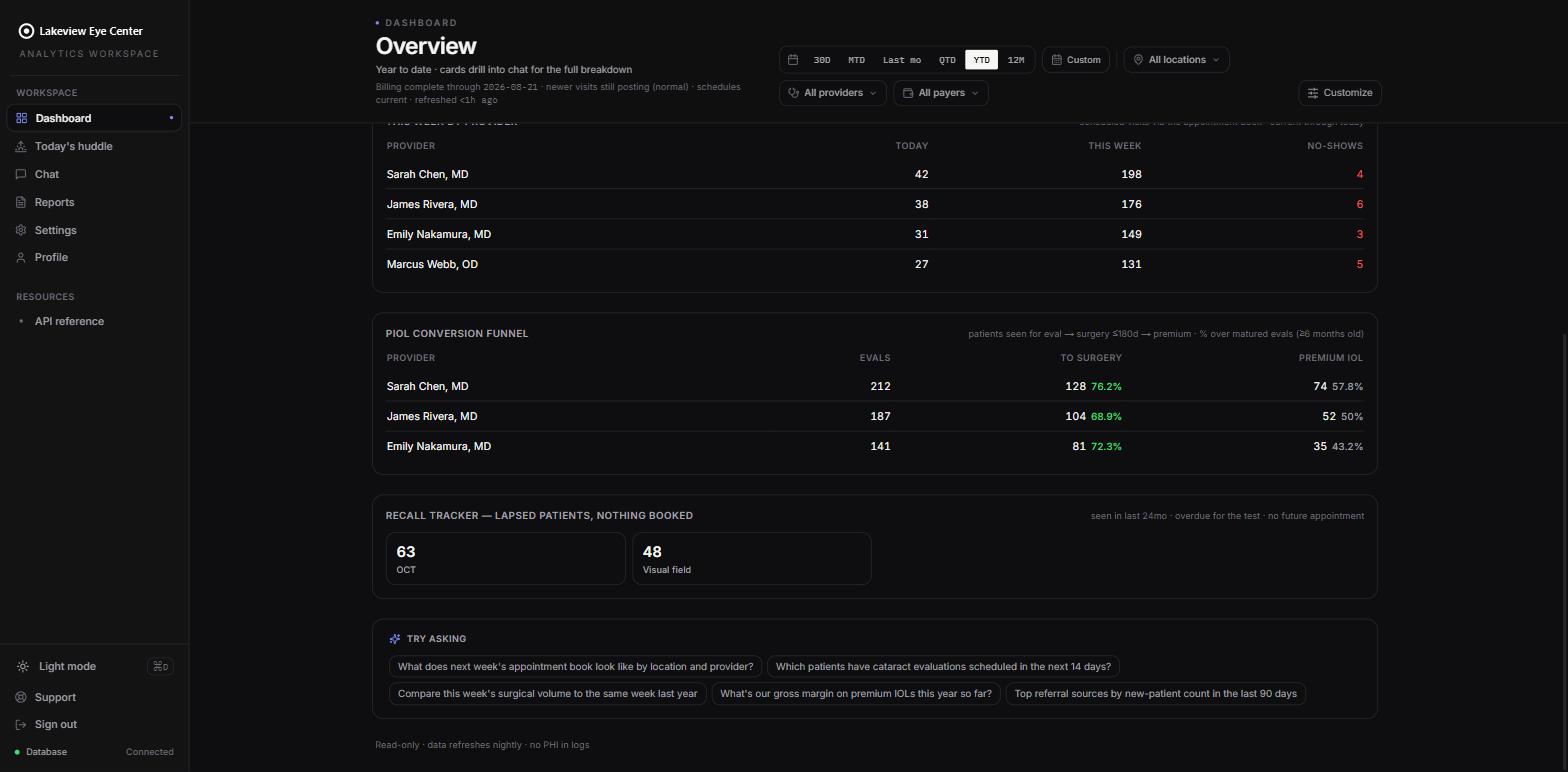
The real conversion funnel and recall tracker. Fictional data throughout.
Built for sensitive patient data.
HIPAA-focused architecture, described plainly and without overclaiming.
Your own database
Each practice has its own subdomain and its own separate database, isolated from other practices.
Role-based, audit-logged
Admin, analyst, billing, front desk, provider, and clinical roles. Financial data is hidden from non-financial roles by default. Data access is audit-logged.
Sensitive fields masked at the database layer
Sensitive patient fields are masked at the database layer, and only the minimum needed is shown to each role.
Azure and AI under BAA
The platform runs on Microsoft Azure under a Business Associate Agreement, and the AI provider is covered by a BAA with abuse-monitoring retention disabled.
We describe our architecture, not your compliance posture. PremNET does not claim HIPAA certification — no such certification exists — and does not promise compliance outcomes on your behalf.
The AI tool your business actually needs.
Analytics is what we built for ophthalmology. The same team builds to order for everyone else: chatbots that know your business, dashboards that know your data, integrations and automations that remove the work nobody wanted to do.
Chatbots
Trained on your products, policies, and documents — answering the questions your team keeps answering by hand.
Dashboards
Your operating numbers in one place, pulled from the systems you already run.
Integrations
Two systems that were never designed to speak, made to speak.
Automations
The recurring manual process, done reliably and on schedule.
Built inside a practice, not a pitch deck.
PremNET's founder is the COO of a working multi-surgeon ophthalmology practice. The practice had a data warehouse subscription and no way to use it: answering a question like how many cataract evals converted to surgery meant a report request, a week of waiting, and a spreadsheet nobody trusted. Meanwhile the patients who had been evaluated and never scheduled sat in the system, unnamed.
So the tooling got built internally — ask in plain English, get the number, get the patient list, make the calls. It ran in a live clinic through surgical seasons, staff turnover, and a payer change before it was ever shown to another practice.
Productizing it came afterwards, because every administrator we described it to asked the same question: can we have that?
Your codes, your providers, your vocabulary
Procedure codes, provider names, appointment types, and costs are editable in the app and feed the AI immediately. You can add your own instructions — "a combo case means cataract + MIGS in the same eye" — and the next answer respects it.
Which systems do you support?
PremNET connects to your practice's EHR data warehouse. Support depends on your EHR and what your vendor makes available. Talk to us about your system.
We've done your job
Payroll, surgical scheduling, payer contracts, a front desk short two people. You won't be explaining the basics.
Nothing ships untested
Features earn their place by being used at 7 AM by staff who have no patience for software.
You talk to the builder
No tiered support queue. The person who changes the product is the person on your call.
See it against your own questions.
A demo is 30 minutes. Bring the question your current reports can't answer — that's the useful test.